How and When to Rebalance Your Portfolio
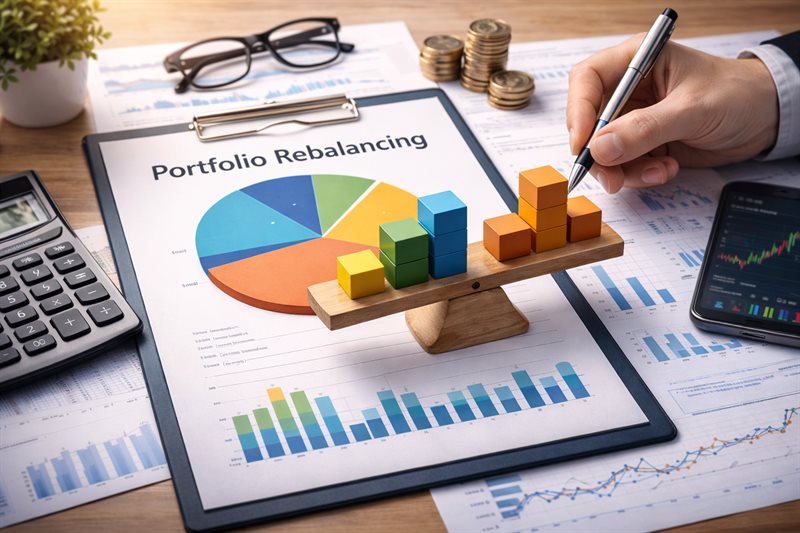
Most investors spend a lot of time thinking about what to buy. Far fewer think carefully about what happens after they buy it.
Your portfolio does not stay still. Markets move, asset prices rise and fall at different rates, and over time the original mix you designed gradually drifts into something you never intended. A portfolio that started as 80% stocks and 20% bonds can shift to 90% stocks and 10% bonds without you touching a single position. That shift changes your risk exposure whether you notice it or not.
Rebalancing is how you fix that. It is the process of bringing your portfolio back to its intended allocation on a deliberate schedule. Done correctly, it is one of the most practical habits a long-term investor can build.
What Is Portfolio Allocation and Why Does It Drift?
When you build a portfolio, you make intentional decisions about how to divide your money across different asset classes, typically stocks, bonds, and cash, and sometimes further divided by geography, sector, or investment style.
That initial breakdown is your target allocation. It reflects your goals, your timeline, and your comfort with risk.
The problem is that different assets grow at different rates. If stocks have a strong year and your bond holdings stay flat, your stock percentage climbs well above your target. You now own a more aggressive portfolio than the one you designed, and you may not realize it until the next market downturn shows you exactly how much risk you were carrying.
Rebalancing corrects that drift by selling what has grown beyond its target weight and buying what has fallen below it.
Why Rebalancing Matters
It keeps your risk level where you intended it
This is the primary reason to rebalance, and it is often underappreciated. Your target allocation was not arbitrary. It was built around your ability and willingness to absorb losses. When drift pushes you far from that target, you are no longer investing according to your actual plan.
It instills a disciplined buy low, sell high habit
Rebalancing forces you to trim positions that have grown large and add to positions that have lagged. It systematically does what most investors know they should do but find emotionally difficult to execute. You are selling strength and buying weakness on a schedule, not based on a feeling.
It prevents overconcentration
Left unchecked, portfolio drift can result in a single stock, sector, or asset class representing a far larger portion of your portfolio than you ever intended. That concentration increases your exposure to a single point of failure.
The Two Main Rebalancing Approaches
Calendar Based Rebalancing
You rebalance on a fixed schedule regardless of how much drift has occurred. Common intervals are quarterly, semi-annually, or annually.
Annual rebalancing is the most widely used approach, and research generally supports it as sufficient for most long-term investors. It is simple, predictable, and easy to build into a routine, such as doing it every January or at the same time you review your taxes.
Best for: Buy and hold investors who prefer a systematic, low maintenance approach.
Threshold Based Rebalancing
You rebalance when a specific asset class drifts beyond a set percentage from its target, such as 5% in either direction. For example, if your target stock allocation is 70% and stocks climb to 76%, that triggers a rebalance regardless of the calendar.
This approach responds to actual market conditions rather than arbitrary dates. It tends to result in fewer rebalancing events during calm markets and more action during volatile ones.
Best for: More hands on investors who monitor their portfolios regularly and want to respond to meaningful drift rather than a calendar.
Combining Both
Many investors use a hybrid: check the portfolio on a schedule, such as quarterly, and only rebalance if drift has exceeded a threshold, such as 5%. This keeps you from over-trading in quiet markets while ensuring you do not go an entire year ignoring meaningful imbalances.
How to Actually Rebalance
Step 1: Know your target allocation
You cannot rebalance toward something you have not defined. Write down your intended allocation clearly. For example: 70% US stocks, 20% international stocks, 10% bonds. Your target should reflect your timeline and risk tolerance, not someone else's.
Step 2: Check your current allocation
Log into your brokerage, tally up the current value of each position, and calculate what percentage each asset class now represents. Most major brokerages display this automatically in a portfolio view.
Step 3: Identify what is over and under target
Compare your current percentages to your targets. Any asset class that has drifted above its target is a candidate for trimming. Any that has fallen below is a candidate for adding to.
Step 4: Make the trades
You have two options:
- Sell and buy: Sell what is overweight and use the proceeds to buy what is underweight. This directly restores the target allocation.
- Direct new money: If you are regularly contributing to your portfolio, direct new contributions toward underweight positions rather than selling anything. This is the more tax-efficient approach when available.
Step 5: Account for taxes
In a taxable account, selling appreciated positions triggers a capital gains tax event. Short-term gains (assets held less than one year) are taxed at your ordinary income rate. Long-term gains (held more than one year) are taxed at the lower capital gains rate.
In a tax-advantaged account such as a traditional IRA, Roth IRA, or 401(k), there is no tax consequence for selling and rebalancing inside the account. This makes tax-advantaged accounts the most efficient place to do your rebalancing activity.
How Often Should You Actually Rebalance?
There is no universally correct answer, but here is a practical framework:
| Your Situation | Suggested Approach |
|---|---|
| Long-term, passive investor | Annual rebalancing is sufficient |
| Contributes regularly to the portfolio | Redirect new money; review annually |
| Active monitor with clear targets | Threshold based at 5% drift |
| Mostly in tax-advantaged accounts | Rebalance freely; no tax concern |
| Mostly in taxable accounts | Minimize sales; use new contributions first |
| Near retirement (within 5 years) | Review more frequently; drift matters more |
Common Mistakes to Avoid
- Rebalancing too often. Overtrading creates unnecessary tax events and transaction costs. Most long-term investors do not need to rebalance more than once or twice a year.
- Ignoring taxes in taxable accounts. The cost of triggering a large capital gains event can outweigh the benefit of perfect allocation. Use new contributions to rebalance when possible.
- Abandoning the target during volatility. Rebalancing during a downturn means buying into a falling market, which is the right move mathematically but a difficult one emotionally. Stick to the process.
- Never revisiting your target allocation. Your target should evolve as your life changes. A 35 year old's appropriate allocation is not the same as a 58 year old's. Revisit your targets when major life events occur.
A Simple Annual Rebalancing Checklist
- Review portfolio once per year on a fixed date
- Calculate current allocation percentages
- Compare to your written target allocation
- Identify assets more than 5% off target
- Rebalance in tax-advantaged accounts first
- Use new contributions to fund underweight positions before selling
- Record the changes and your reasoning
- Update target allocation if your life situation has changed
When to Reset Your Allocation Entirely
Rebalancing brings your portfolio back to its target. But sometimes the target itself needs to change. Life events can shift your timeline, your income, or your tolerance for risk in ways that make your current allocation no longer appropriate, regardless of how well it was designed when you set it.
The following changes should prompt you to step back and reconsider your allocation from scratch rather than simply rebalancing back to the old one:
- Getting married or divorced. A combined household income changes how much risk you can absorb. A divorce can do the opposite, reducing financial cushion and shortening effective timelines.
- Having children. New financial obligations, college savings goals, and the need to protect income typically call for a more conservative posture.
- A major income change. A significant raise, a job loss, or a career shift changes how much risk you can afford to take with your invested assets.
- Approaching retirement. As your timeline shortens, the ability to recover from a large drawdown decreases. Most investors gradually shift toward a more conservative allocation in the years leading up to retirement.
- Receiving an inheritance or windfall. A sudden increase in investable assets changes the overall picture and often warrants a full portfolio review.
- A major health change. A serious health event can shorten time horizons and change both income expectations and liquidity needs.
- Retiring. The shift from accumulation to drawing down assets is one of the most significant allocation decisions you will make. Income generation, sequence of returns risk, and capital preservation all become primary concerns.
When any of these apply, the right move is not to rebalance back to your old targets. It is to define new ones first, then build toward them.
One straightforward way to do that is with the QuickInvestIQ ETF Portfolio Builder. It walks you through seven questions about your goals, timeline, and risk tolerance, and outputs a diversified ETF allocation you can use as your new target. From there, your next rebalance becomes the starting point for the updated plan.
The Bottom Line
Rebalancing is not exciting. It does not involve finding the next great stock or timing the market perfectly. What it does is protect the integrity of the portfolio you built, keep your risk exposure where you intended it, and create a repeatable discipline that works in your favor over decades.
Most investors rebalance annually. Most benefit from doing it in tax-advantaged accounts first. And most would be better served by a consistent, boring rebalancing routine than by chasing better performance with a portfolio that has quietly drifted far from their original plan.
Build the habit. Set the date. Do the work once a year. That is enough.
← Return to Site
This article is for educational purposes only and does not constitute investment advice. QuickInvestIQ is not a registered investment advisor. Always conduct your own due diligence before making investment decisions.
— QuickInvestIQ