Trading Tools for Spotting Trends
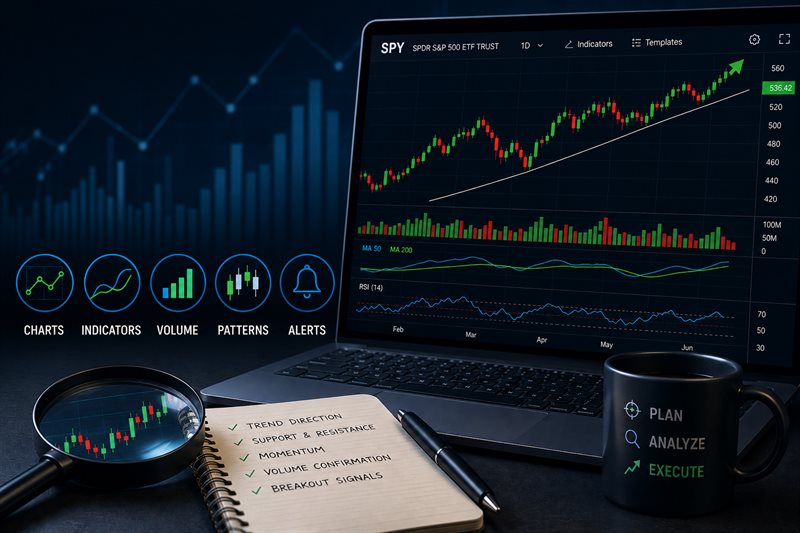
Before you can trade a trend, you have to see one. Most new traders spend too much time looking for the perfect entry signal and not enough time understanding what the market is actually doing. Trends are the foundation. If you can read the direction the market is moving and respect the levels where it tends to pause or reverse, you are already ahead of a lot of retail traders.
The tools below are not magic formulas. They are structured ways of seeing what price is doing and where it has been. Use them together, not in isolation.
Trendlines
A trendline is the simplest trend tool there is: a straight line drawn across a series of price highs or lows. Uptrends connect higher lows. Downtrends connect lower highs. The line gives you a visual rail that price has been riding, and it highlights the moment price breaks away from that path.
To draw a valid trendline, you generally need at least two confirmed points, though three or more makes the line much more meaningful. The more times price touches the line without breaking through it, the more traders are watching that level.
A trendline break is not automatically a trade signal. Look for confirmation: a candle closing clearly beyond the line, increased volume on the break, or a retest of the line from the other side before acting on it.
Support and Resistance
Support is a price level where demand has historically stepped in and stopped a decline. Resistance is a level where selling pressure has historically pushed price back down. These are the floors and ceilings of the market, and they matter because traders have memory. The levels that mattered before tend to matter again.
Horizontal support and resistance lines are drawn across price points where the market repeatedly stalled, bounced, or reversed. Unlike trendlines, these are flat. You are looking at a specific price, not a slope. Strong levels are confirmed by multiple touches over different time periods.
One important concept: when price breaks through a resistance level and closes above it convincingly, that level often flips to support. The logic is straightforward: the price point that sellers defended now becomes the level that buyers are willing to defend. Traders call this a role reversal.
- More touches of a level over longer timeframes make it more significant
- Higher timeframes matter more. Levels on weekly or monthly charts carry more weight than those on a 5-minute chart
- Think in zones, not lines. A level does not have to hold to the penny to be valid
Moving Averages
A moving average (MA) plots the average closing price of a stock over a set number of periods (20 days, 50 days, 200 days) and updates with each new candle. The result is a smooth line that filters out the day-to-day noise and shows you the underlying trend direction more clearly.
The two most common types are the Simple Moving Average (SMA), which weights all periods equally, and the Exponential Moving Average (EMA), which gives more weight to recent prices and reacts faster. Most active traders lean toward EMAs for short-term work. Longer-term investors often use SMAs to keep from reacting to every small move.
Moving averages serve two roles: they show trend direction, and they act as dynamic support and resistance. Many traders watch whether price is trading above or below the 50-day or 200-day MA as a quick read on longer-term momentum. When a shorter-term MA crosses above a longer-term one, that is often called a golden cross and signals improving momentum. The reverse is called a death cross, which occurs when a shorter-term MA drops below a longer-term one.
The 20/50 EMA combination works well for short to mid-term swing trading. The 50/200 SMA pairing is more commonly used by position traders and investors tracking broader trend health.
Volume
Volume measures how many shares changed hands during a given period. On its own, a price move does not tell you much about conviction. Volume tells you whether that move matters. A stock rallying on heavy volume has real participation behind it. The same rally on thin volume is much less reliable.
The core principle is simple: price moves that align with above-average volume are more likely to continue. Price moves that happen on below-average volume are more likely to be noise or a short-lived move that fades.
- Breakouts on high volume are far more reliable than those on thin volume
- Pullbacks on light volume during an uptrend are typically a healthy sign. Sellers are not committing
- Sharp drops on massive volume can signal capitulation or a major shift in sentiment
- Volume confirms, it does not lead. Price moves first, then check whether volume validates it
RSI (Relative Strength Index)
The Relative Strength Index (RSI) is a momentum oscillator that measures the speed and size of recent price changes. It runs on a scale from 0 to 100. Readings above 70 are generally considered overbought, meaning the move may be stretched and due for a pause or pullback. Readings below 30 are generally considered oversold, meaning the selling may be excessive and a bounce could be near.
The RSI does not tell you when to buy or sell on its own. In a strong uptrend, a stock can stay overbought for weeks. What RSI is really useful for is spotting divergence. When price makes a new high but RSI does not, that is a signal that momentum is fading even if the move looks strong on the surface.
Bearish divergence: price hits a higher high, RSI hits a lower high. This suggests weakening momentum. Bullish divergence is the reverse: price makes a lower low but RSI makes a higher low, suggesting selling pressure is easing before price shows it.
RSI is typically set to a 14-period default, but shorter-term traders often use 9 or 7 periods for more sensitivity. Longer settings smooth it out and generate fewer, but potentially higher-quality, signals.
MACD
MACD combines trend-following and momentum in a single indicator. It measures the difference between a 12-period EMA and a 26-period EMA, then plots a 9-period signal line on top of that. When the MACD line crosses above the signal line, it can indicate building upside momentum. When it crosses below, momentum may be turning negative.
The histogram bars below the lines show the gap between MACD and the signal line. When the bars are growing, momentum in that direction is strengthening. When they shrink, even if the price is still moving, momentum is weakening, and that early warning is often more useful than the crossover itself.
- Centerline crossovers (MACD crossing above or below zero) signal a shift in the underlying trend
- Histogram divergence (shrinking bars while price extends) is an early warning of momentum loss
- Best on daily and weekly charts. MACD lags too much on very short timeframes to be reliable
- Never use it alone. MACD is most useful when it aligns with what price action and volume are already telling you
Using These Tools Together
No single indicator wins every time. The real value comes from stacking them: using trendlines and support levels to define the structure, moving averages to confirm the trend, volume to validate moves, and RSI or MACD to gauge momentum and spot early warning signs.
Think of each tool as one data point in a probability assessment. The more signals that line up in the same direction, the higher the probability of a clean trade. That is not a guarantee, but it is how you put the odds in your favor.
← Return to Site → Get Free Stock Trading Starter Guide— QuickInvestIQ